
AKC S.T.A.R. PUPPY

The AKC S.T.A.R. Puppy Program is an exceptional incentive program for dedicated dog owners who invest the time to take their companions through foundational training. When you complete a basic puppy course with an authorized AKC Approved CGC Evaluator, your puppy (up to one year old) becomes eligible for official enrollment.
After completing a minimum six-week training course, I will administer the official AKC S.T.A.R. Puppy test. Upon passing, you will receive your official application to enroll. All purebred and mixed-breed puppies are warmly welcomed to participate.
Passing puppies receive the official AKC S.T.A.R. Puppy Medal and are permanently recorded in the national AKC registry. To support your ongoing education beyond the classroom, your enrollment package from the AKC includes:
- A beautiful, frameable certificate designating your puppy is in the AKC S.T.A.R. Puppy records at AKC
- AKC Puppy Handbook, a valuable resource for develpmental care
- Ongoing monthly digital newsletter packed with essential training tips and up-to-date health information.
Collar, Leashes and Equipment
Official AKC Equipment RequirementsTo ensure compliance with national testing standards, all evaluations must be performed safely on a leash. According to the official rules of the American Kennel Club, dogs must be presented on the following approved gear:
-
- A well-fitting standard buckle collar, slip collar, or martingale collar.
- A standard body harness that does not restrict the dog’s natural movement.
- A standard six-foot leash made of either durable leather or fabric.
Please note that specialized or aversive training equipment—including prong/pinch collars, electronic collars, head halters, and retractable leashes—is strictly prohibited during any official AKC evaluation.

AKC CANINE GOOD CITIZEN
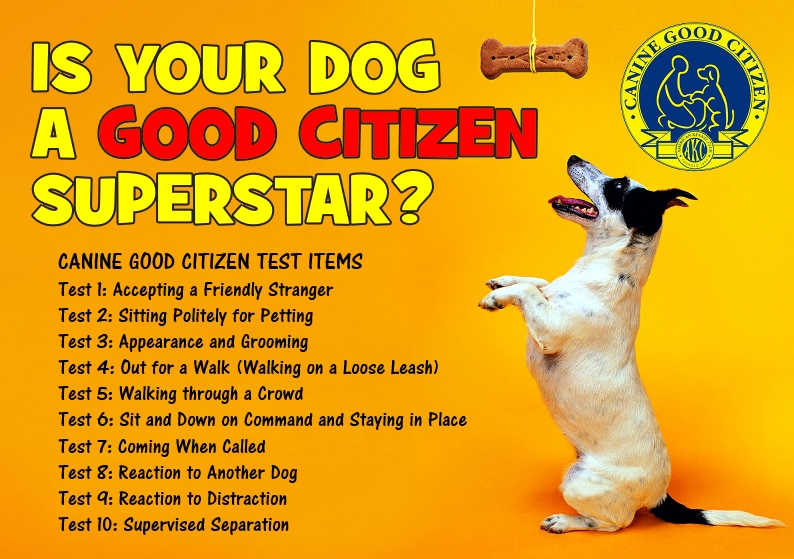
The AKC Canine Good Citizen™ (CGC) program is designed to help you and your dog be the best team you can be through positive training and a strong bond. The official AKC Canine Good Citizen (CGC) test is a 10-part evaluation that assesses a dog’s manners, social skills, and handler communicationm in everyday real-world situations.
As a non-competitive program open to all dogs of any age or breed, the CGC focuses heavily on responsible pet ownership and helps prepare dogs for public outings, therapy work, and other activities. Passing the CGC test will guide you toward responsible dog ownership. Passing this milestone serves as the foundational gold standard to help prepare your dog for further training like AKC Trick Dog or AKC Therapy Dog. But perhaps most importantly, this process instills vital, reliable life skills that will benefit you and your companion no matter where your adventures take you.
While there is no official minimum age to participate, puppies under one year of age are typically best suited to start in the AKC S.T.A.R. Kokua Dog Training provides dedicated, step-by-step preparation courses to help you master these 10 essential skills with total confidence before taking or retaking the test.”
AKC Community Canine® is the advanced level of the AKC’s Canine Good Citizen program. Dogs who successfully pass this evaluation earn the official national title, designated by the letters CGCA (Advanced CGC) on their permanent record.i
While the standard Canine Good Citizen evaluation is typically conducted in a controlled ring using simulated situations (such as helpers acting as a crowd), the CGCA evaluation is performed entirely in real-world environments. This includes active class settings, community locations, and public spaces, ensuring your dog can confidently generalize their manners and focus amidst true everyday distractions.”
AKC Urban CGC™ requires a dog to demonstrate proficient Canine Good Citizen skills within a bustling city or town setting. Evaluated entirely on a leash, this advanced test is administered in real-world environments featuring active traffic, crowds, street crossings, public noises, and novel scents. To be eligible for this evaluation, a dog must already have an official Canine Good Citizen (CGC) title on record with the AKC
Important Ethical Advisory from the AKC: Passing the Urban CGC or standard Canine Good Citizen evaluation does not grant a pet dog status as a service dog or an emotional support animal. A key legal and behavioral distinction of authentic service and emotional support animals is that the handler has a verified disability. Misrepresenting a companion pet as a service or emotional support animal is highly unethical and undermines the critical access required by individuals with legitimate needs.